

Search:
When AI Meets Journalism: Navigating Legal Minefields in UK Newsrooms
UK newsrooms adopting AI face growing legal risks around liability and source protection, with outdated laws struggling to keep pace.

Artificial Intelligence is no longer an emerging trend in journalism. It is already here, shaping headlines, accelerating workflows, and creating legal headaches that UK law simply is not equipped to handle.
According to Gordon*, a UK-based media lawyer, publishers face a perfect storm of challenges when it comes to Generative AI (Gen AI). Beyond the well-documented concerns around unauthorised data scraping, newsrooms must now navigate an entirely new landscape of risks that strike at journalism’s core principles.
The Trust Problem
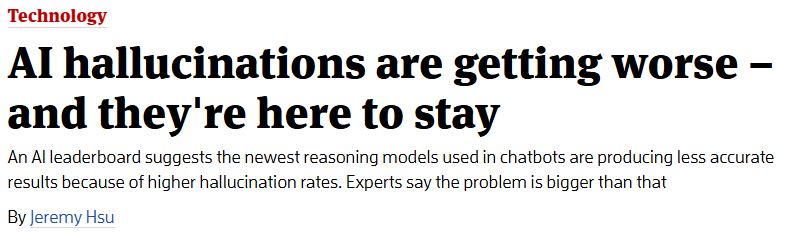
Protecting sources and verifying information form the backbone of good journalism, but these fundamentals become complicated when you have a digital colleague that is prone to hallucinations. The implications for editorial integrity are clear.
“Those opting for open Gen AI models face a stark reality…confidential information or source identities could be exposed at any moment”
“Not all [Gen] AI tools offer private secure instances and those that do can be costly,” advises Gordon. For cash-strapped newsrooms, this presents an uncomfortable choice: compromise on privacy or stretch already tight budgets.
He warns, “Those opting for open Gen AI models face a stark reality… confidential information or source identities could be exposed at any moment”.
Then there is the question of accountability. Who bears responsibility when false or defamatory content slips through? If legal action follows, journalists may struggle to recreate the exact prompts they used, and even if they can, there’s no guarantee a future version of the model will produce identical results.
Already in the Newsroom
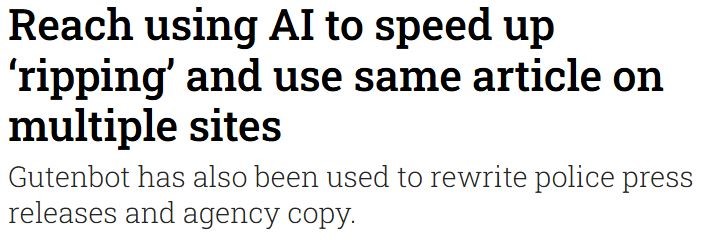
Despite these concerns, AI adoption is gathering pace across UK media.
Reach plc, one of the country’s largest regional publishers, has openly acknowledged using Generative AI both to write content and to localise national stories across its network.
For publishers under relentless pressure to produce high volumes of content, AI’s appeal is undeniable.
“Many in-house lawyers are really concerned about AI use and don’t want their journalists using it”

Yet even where editorial management pushes for AI adoption, internal conflicts are brewing. “Many in-house lawyers are really concerned about AI use and don’t want their journalists using it at all,” Gordon reveals, “meanwhile, editors focused on content volume are often pushing in the opposite direction.”
The situation becomes even murkier under hybrid working arrangements, where journalists might turn to Gen AI at home, completely outside of editorial supervision.
When Law Meets AI
The legal landscape presents perhaps the thorniest challenge. “If AI-generated content is published and turns out to be false or defamatory, the publisher is responsible,” warns Gordon.
However, he notes that under common law, the originator may also face liability, raising complex questions about shared responsibility when AI enters the content creation process.
“If AI-generated content is published and turns out to be false or defamatory, the publisher is responsible”
The legal threshold for defamation claims adds another layer of complexity. Gordon explains, “Defamation claims must meet a legal threshold where serious harm must be proven. There must be publication to at least one third party and if a journalist is the only person who sees the AI-generated statement, that may not meet the threshold.” He adds, “But if it goes live across print and online platforms, the impact could be far greater.”
“Defamation claims must meet a legal threshold where serious harm must be proven…if it goes live across print and online platforms, the impact could be far greater”
Technology platforms have historically dodged libel claims because they did not generate content, but Gen AI platforms operate differently. Despite broad liability waivers in their terms and conditions warning users not to rely on outputs, Gordon suggests such disclaimers may prove insufficient when facing legal challenges.
Testing the Waters

A case currently being prepared in Ireland could challenge accountability entirely. In June, reports emerged that Gerry Adams’ legal team is preparing a defamation claim against Meta AI.
His lawyer, Paul Tweed, argues that statements generated by chatbots on Facebook and Instagram during Adams’ libel case against the BBC fall outside traditional platform protections.
Tweed’s position is clear: because chatbots generate new content, the companies behind them should be considered publishers. Speaking to the Irish Independent, he expressed hope that the case would challenge the legal shield platforms have previously relied upon.
Outdated Laws, New Problems
Gordon highlights another flaw within the current legal framework. The last significant change to defamation law came in 2013 to accommodate websites, but Gen AI operates nothing like traditional platforms or databases.
Until laws catch up, courts and lawyers face the unenviable task of stretching legislation designed for web operators to cover an entirely different type of system.
The Source Protection Crisis

Beyond defamation, Gordon raises alarming concerns about confidentiality and data security. “If you use a GenAI tool that further develops its system using input data,” he explains, “then, if there is a reverse prompt attack by a malicious actor, the info you input could be regurgitated verbatim to a third party.” For journalists handling confidential sources, this represents an existential threat.
Section 10 of the Contempt of Court Act 1981 protects journalists from forced disclosure of their sources, but these protections crumble if sensitive information accidentally surfaces through Gen AI systems. Whether through targeted prompting or outright hacks, the risk is real.
“If you’re a journalist and you receive information from a confidential source, and you disclose it to a third party, even unwittingly, you could be liable for a claim from the source for misuse of private information and/or breach of confidence,” says Gordon. Such breaches could also violate editorial requirements to act in sources’ best interests.
Technical Solutions and Their Limits
Workarounds exist, but they are far from simple. Gordon suggests running Gen AI on private servers, “within your own walls”, to keep input data secure. Local deployment means information is not fed back into shared models, reducing leakage risks.
“The courts will expect an audit trail…Gen AI is a blackbox”
Maintaining audit trails presents another challenge. “If journalists are using AI, the courts will expect an audit trail,” says Gordon. “Gen AI is black box technology, so years down the line it would be hard to look back and show what prompts were used and what information came out. They need to have a record in case they are challenged on whether what they published was in the public interest.”
Gordon cites a troubling example from June this year involving Meta AI on WhatsApp, where a chatbot provided a real, private WhatsApp user’s phone number when asked for a business helpline. When challenged, the bot first claimed to have pulled the number from a database, then later insisted it had generated it randomly. This incident, Gordon argues, demonstrates how information can “bleed out” even within encrypted systems.
The Disclosure Dilemma
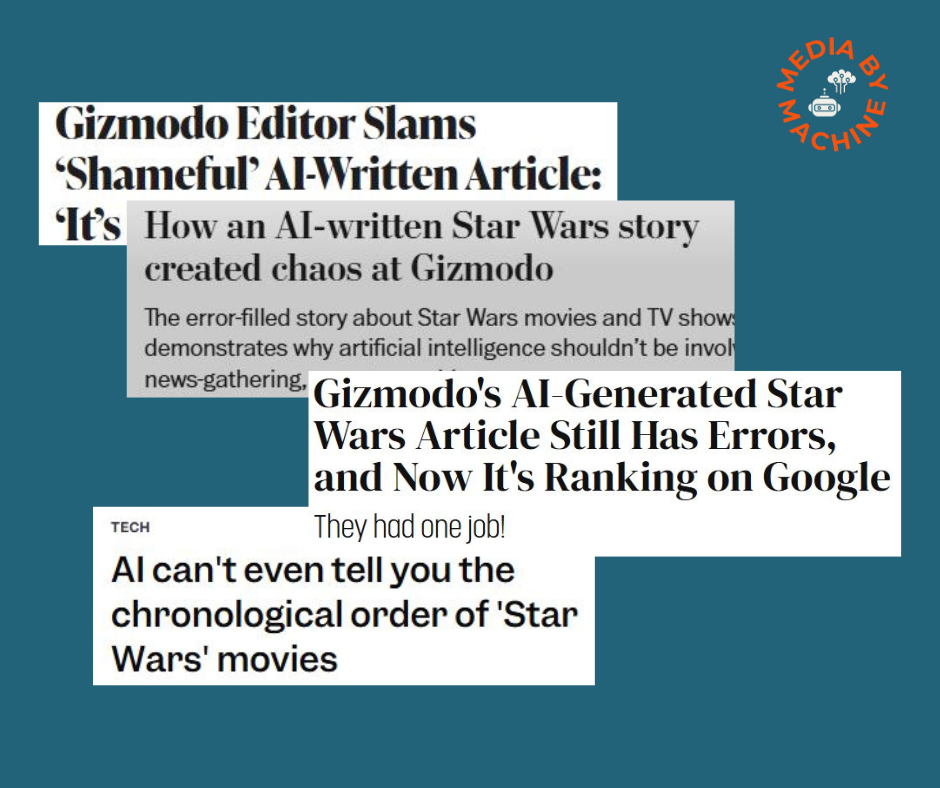
Currently, UK publishers face no legal requirement to disclose Gen AI use. While Gordon acknowledges that mandatory disclosure rules would prove difficult to enforce, he warns of reputational risks if organisations appear to hide their AI usage when problems arise.
He points to G/O Media’s publication Gizmodo as an example. It published a simple Star Wars film listicle in the wrong order and only later was it revealed to have been be AI-generated content.
Urgent Need for Reform
Gordon identifies two areas requiring immediate legal attention. First, the liability framework for unlawful publication (including breach of confidence, misuse of private information, and defamation), when AI plays a role. Second, the complete absence of legal protection for proprietary publisher data that may be scraped or reused by AI systems operating outside of UK jurisdiction.
These challenges are “compounded by the government’s pro-AI stance, which has prioritised attracting investment over addressing gaps in regulation and law,” he notes.
A Cautious Way Forward
In the absence of clear guidance, Gordon’s advice is straightforward: “Treat AI no differently to any other unreliable source.” He urges journalists to “presume that information entered into a shared system might be shared more widely in future,” regardless of original intentions.
“Treat AI no differently to any other unreliable source”
The technology is racing ahead whilst the legal system lags behind. For now, the burden of managing these risks falls squarely on those using Gen AI, not the technology providers creating it. Until lawmakers catch up, newsrooms must navigate this new landscape with little more than caution and common sense as their guides.
*Name changed to protect confidentiality.
Follow Media by Machine
Share this article
More News & Explainers

Our New Survey: What the Public Really Thinks About Gen AI in the Newsroom

Google AI Launch Escalates ‘Zero Click’ Crisis for UK News Publishers

UK Data Law Fails Creatives, Sparking Fury Over AI Exploitation
