

Search:
UK Data Law Fails Creatives, Sparking Fury Over AI Exploitation
The UK’s Data (Use and Access) Act 2025 introduces no new protections for creators, leaving AI firms free to scrape work without consent.

The UK’s new data law is here, and it’s already facing fierce criticism from across the creative industries. Despite months of lobbying, the Act has passed without introducing a single enforceable legal safeguard for the creative industries, whose work is already being used to train artificial intelligence systems.
The legislation, which received Royal Assent on 19 June and comes into force on 20 August, does not require AI firms to disclose their training data nor seek permission before using copyright works.
That omission has sparked fury from artists, publishers and campaigners, who say the government has ignored the growing threat of AI-driven exploitation.
“The government are just being absolute losers and I’m very angry about it, as you can tell”
Elton John is among them. In a recent interview with the BBC’s Laura Kuenssberg, he shared concerns for young people in creative industries being unable to make a living, saying, “The government are just being absolute losers and I’m very angry about it, as you can tell”.
Groups such as the Media Lawyers Association, which represents creators across journalism, publishing and the arts, urged ministers to introduce a legal duty of transparency. They called for tech firms to publish what content they had scraped and to obtain consent from rights holders before using copyrighted material. An amendment to this effect, led by Baroness Kidron in the House of Lords, was ultimately thrown out by MPs.

Instead, the final Act entrenches the existing loophole: a text and data mining exception that allows copyright works to be harvested for AI training.
Far from strengthening protections, the government has introduced an opt-out system, known as a rights reservation mechanism, which shifts the burden onto creators to stop their work being used.
Critics argue this approach is both unfair and unworkable. It relies on individual creators navigating complex legalities, while AI firms continue to benefit, often without ever disclosing what they’ve taken. They also warn that many AI web-crawlers now ignore the robots.txt exclusion protocol, the only defence most websites have against automated scraping.
Forbes Magazine
The risks are real. In the US, Perplexity AI allegedly used a Forbes article to generate an AI-written news story, podcast and YouTube video – all under its own brand and without crediting the original publisher.
In response to a request for comment, CEO Aravind Srinivas reportedly said the company would consider making attribution more prominent in future iterations of the product (as reported by Forbes, June 2024). He did not address concerns about using the content without permission.
Mumsnet
In the UK, parenting platform Mumsnet launched a landmark lawsuit against OpenAI, accusing the company of scraping six billion words from its forums without consent to train ChatGPT.
“We approached OpenAI and suggested they might like to licence our content. Their response was that they were more interested in datasets that are not easily accessible online”
The site claims this breaches both UK copyright law and its own terms of use.
“We approached OpenAI and suggested they might like to licence our content. Their response was that they were more interested in datasets that are not easily accessible online,” Mumsnet chief executive Justine Roberts said, as the parenting platform initiated legal proceedings in the UK against the company.
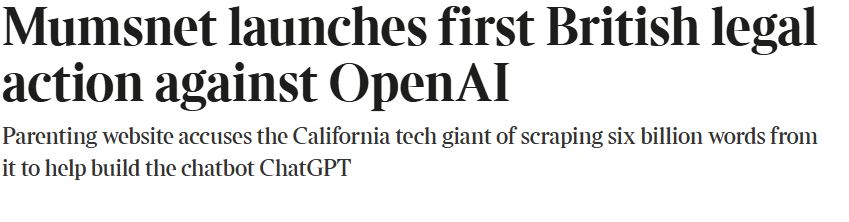
Roberts warned, “The LLMs are building models like ChatGPT to provide the answers to any and all prospective questions…with scraped content from the websites they are poised to replace”.
Many US tech giants defend such practices under America’s “fair use” doctrine, but this legal protection does not exist in the UK.
Getty Images
Getty Images brought action against Stability AI, arguing it scraped millions of copyright works to train the Stable Diffusion image generator. That UK case stalled when Stability claimed its training took place in the US and was therefore beyond the reach of UK law. Getty is now pursuing the case in the American courts.

Despite widespread concern, the UK government insists that any changes to copyright must be handled through separate reforms. Until then, AI firms have no obligation to seek permission, disclose what they’re using, or even admit when copyright works are in their systems.
Campaigners say this leaves UK creators dangerously exposed, at a time when AI is upending the business models of journalism, publishing and the arts.
Many believe the government has squandered a vital opportunity to show leadership on ethical AI, failing those who keep the UK’s creative industries alive.
Follow Media by Machine
Share this article
More News & Explainers

When AI Meets Journalism: Navigating Legal Minefields in UK Newsrooms

Our New Survey: What the Public Really Thinks About Gen AI in the Newsroom

Google AI Launch Escalates ‘Zero Click’ Crisis for UK News Publishers
